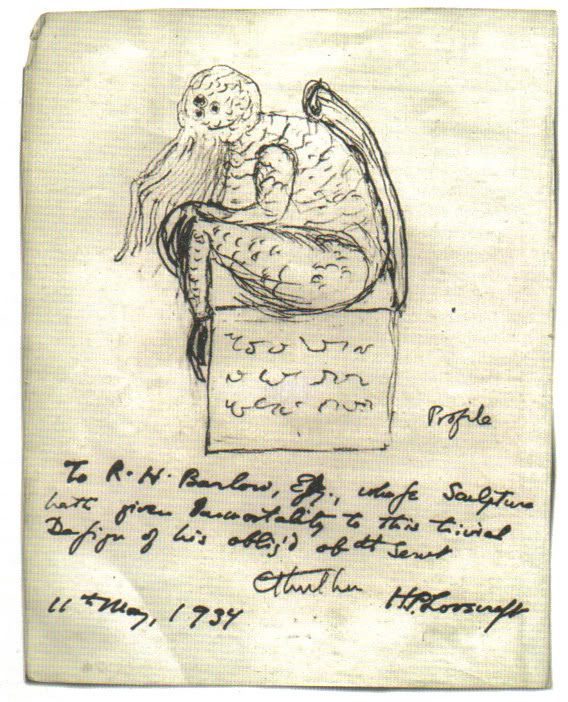
Cthulhu dessiné par Lovecraft lui-même, 1934 — H. P. Lovecraft · Public domain · Commons

Rapport
13 œuvres sur 222, 44 occurrences — 23ᵉ entité la plus citée du wiki sur 139. Parutions transcrites de 1928 (L’Appel de Cthulhu) à 1954 (Le Survivant), sur 10 œuvres datées. (dates des numéros transcrits, posthumes comprises.) Le foyer est L’Appel de Cthulhu : 22 occurrences, 50 % du total. Densité : 2,9 occurrences pour 10 000 mots dans les œuvres concernées. Voisine surtout R’lyeh : 17 rapprochements dans un même passage. 8 fiches du wiki y renvoient.
Cthulhu n’est pas un dieu au sens où il exigerait un culte : il dort, et son sommeil suffit à déranger la planète. Lovecraft le décrit comme une masse composite — tête de céphalopode, corps écailleux, ailes rudimentaires — mais insiste surtout sur ce qui échappe à la description : la statuette que manipule l’inspecteur Legrasse n’appartient à aucune école de sculpture connue.
Sa puissance est onirique avant d’être physique. Quand R’lyeh remonte, ce sont les artistes et les fous qui le sentent les premiers, longtemps avant les marins. Le culte n’attend pas son réveil comme une délivrance mais comme une évidence : « ils enseigneraient aux hommes de nouvelles façons de crier, de tuer et de se réjouir ».
La formule Ph’nglui mglw’nafh Cthulhu R’lyeh wgah’nagl fhtagn — « en sa demeure de R’lyeh, Cthulhu mort attend en rêvant » — est le seul énoncé du mythe que Lovecraft ait répété assez pour qu’il devienne une signature.
Attestations dans le corpus
| Œuvre | Année | Occurrences | Part |
|---|---|---|---|
| L’Appel de Cthulhu | 1928 | 22 | 50 % |
| Celui qui chuchotait dans les ténèbres | 1931 | 5 | 11 % |
| Le Cauchemar d’Innsmouth | 1936 | 4 | 9 % |
| Le Survivant | 1954 | 3 | 7 % |
| L’Horreur dans le musée | 1933 | 2 | 5 % |
| Autobiography | 1943 | 1 | 2 % |
| History of the Necronomicon | — | 1 | 2 % |
| Letter to Clark Ashton Smith, November 27, 1927 | — | 1 | 2 % |
| La Chevelure de Méduse | — | 1 | 2 % |
| L’Abomination de Dunwich | 1929 | 1 | 2 % |
| The Notes & Commonplace Book | 1938 | 1 | 2 % |
| À travers les portes de la Clef d’argent | 1951 | 1 | 2 % |
| Mort ailée | 1932 | 1 | 2 % |
| Total | 44 |
Ce que le corpus en dit
Une phrase par œuvre, prise à l’endroit de la première occurrence.
What seemed to be the main document was headed “CTHULHU CULT” in characters painstakingly printed to avoid the erroneous reading of a word so unheard-of.
— L’Appel de Cthulhu, 22 occurrences
I suppose you know all about the fearful myths antedating the coming of man to the earth—the Yog-Sothoth and Cthulhu cycles—which are hinted at in the Necronomicon.
— Celui qui chuchotait dans les ténèbres, 5 occurrences
Cthulhu fhtagn! Ph’nglui mglw’nafh Cthulhu R’lyeh wgah-nagl fhtagn—” Old Zadok was fast lapsing into stark raving, and I held my breath.
— Le Cauchemar d’Innsmouth, 4 occurrences
This was a sequence of cryptic references to certain mythological creatures, particularly one named “Cthulhu,” and another named “Dagon,” who were evidently deities of the sea in some ancient mythology completely unknown to me; and suggestions of long-lived creatures (or people?) who served these ancient Gods, named the “Deep Ones,” evidently amphibious creatures living in the depths of the seas.
— Le Survivant, 3 occurrences
Others were drawn from darker and more furtively whispered cycles of subterranean legend—black, formless Tsathoggua, many-tentacled Cthulhu, proboscidian Chaugnar Faugn, and other rumored blasphemies from forbidden books like the Necronomicon, the Book of Eibon, or the Unaussprechlichen Kulten of von Junzt.
— L’Horreur dans le musée, 2 occurrences
About 1919 the discovery of Lord Dunsany—from whom I got the idea of the artificial pantheon and myth-background represented by “Cthulhu,” “Yog-Sothoth,” “Yuggoth,” etc.—gave a vast impetus to my weird writing; and I turned out material in greater volume than ever before or since.
Rencontres dans le texte
Entités dont une occurrence figure à moins de 320 signes de celle-ci — même phrase ou phrase voisine.
The chant meant only this: “In his house at R’lyeh dead Cthulhu waits dreaming.” Only two of the prisoners were found sane enough to be hanged, and the rest were committed to various institutions.
— L’Appel de Cthulhu, avec R’lyeh
All in the band of the faithful—Order o’ Dagon—an’ the children shud never die, but go back to the Mother Hydra an’ Father Dagon what we all come from onct … Iä! Iä! Cthulhu fhtagn!
— Le Cauchemar d’Innsmouth, avec Dagon
Croisements
Entités qui partagent ses œuvres, les plus spécifiques d’abord ; entre parenthèses, le nombre d’œuvres communes.
Personnages — Abdul Alhazred (7), Capitaine Obed Marsh (2), Harley Warren (3)
Divinités — Yog-Sothoth (8), Shub-Niggurath (5), Dagon (3), Tsathoggua (3)
Créatures — Les Grands Anciens (5), Les Anciens (4), Les Profonds (2)
Lieux — Arkham (9), La Nouvelle-Orléans (5), R’lyeh (4), Yuggoth (5), Salem (7), Irem (4), Université Miskatonic (5), Le Récif du Diable (2)
Objets — Le Necronomicon (9), Les Manuscrits pnakotiques (4)
Thématiques — Le document comme preuve (2), Le narrateur qui ne peut pas dire (2), Le racisme de Lovecraft (2)
Époques — Les années 1920 (2)
Cycles — Le mythe de Cthulhu (4)
Entourage — Clark Ashton Smith (5)
Dans les revues
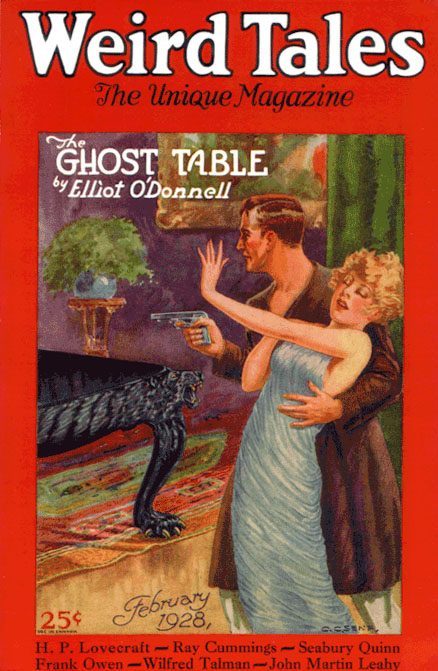
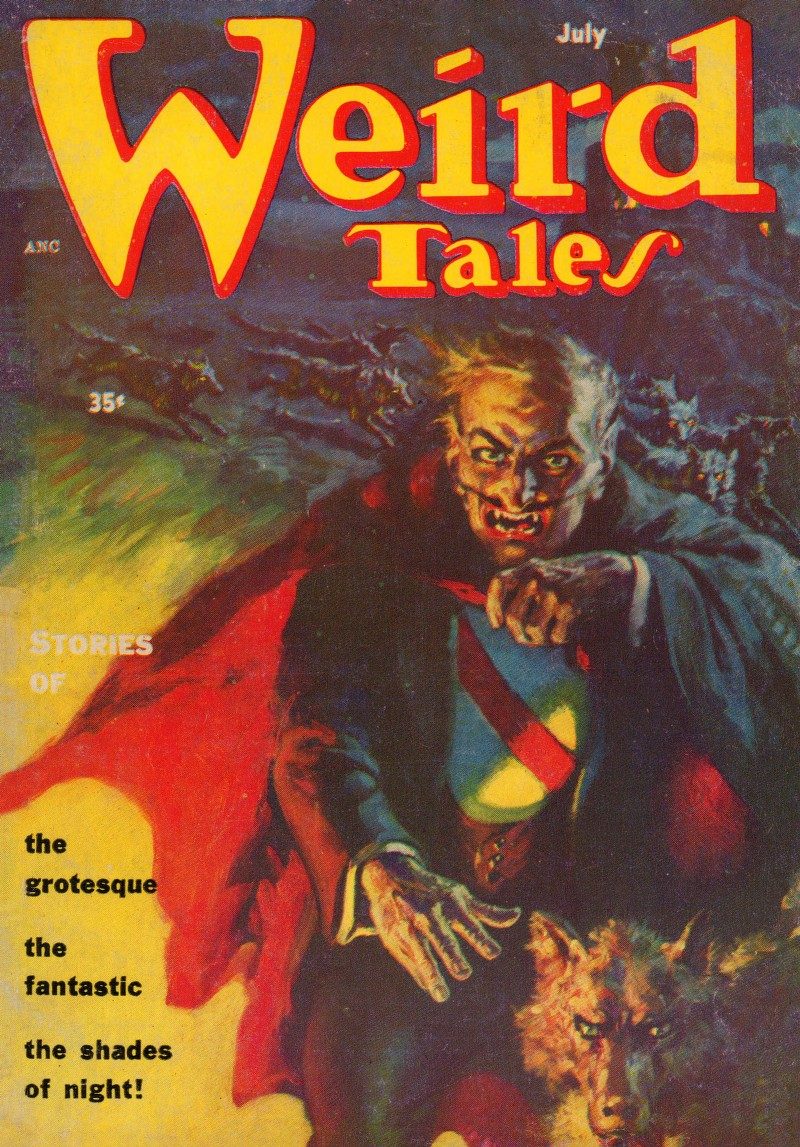
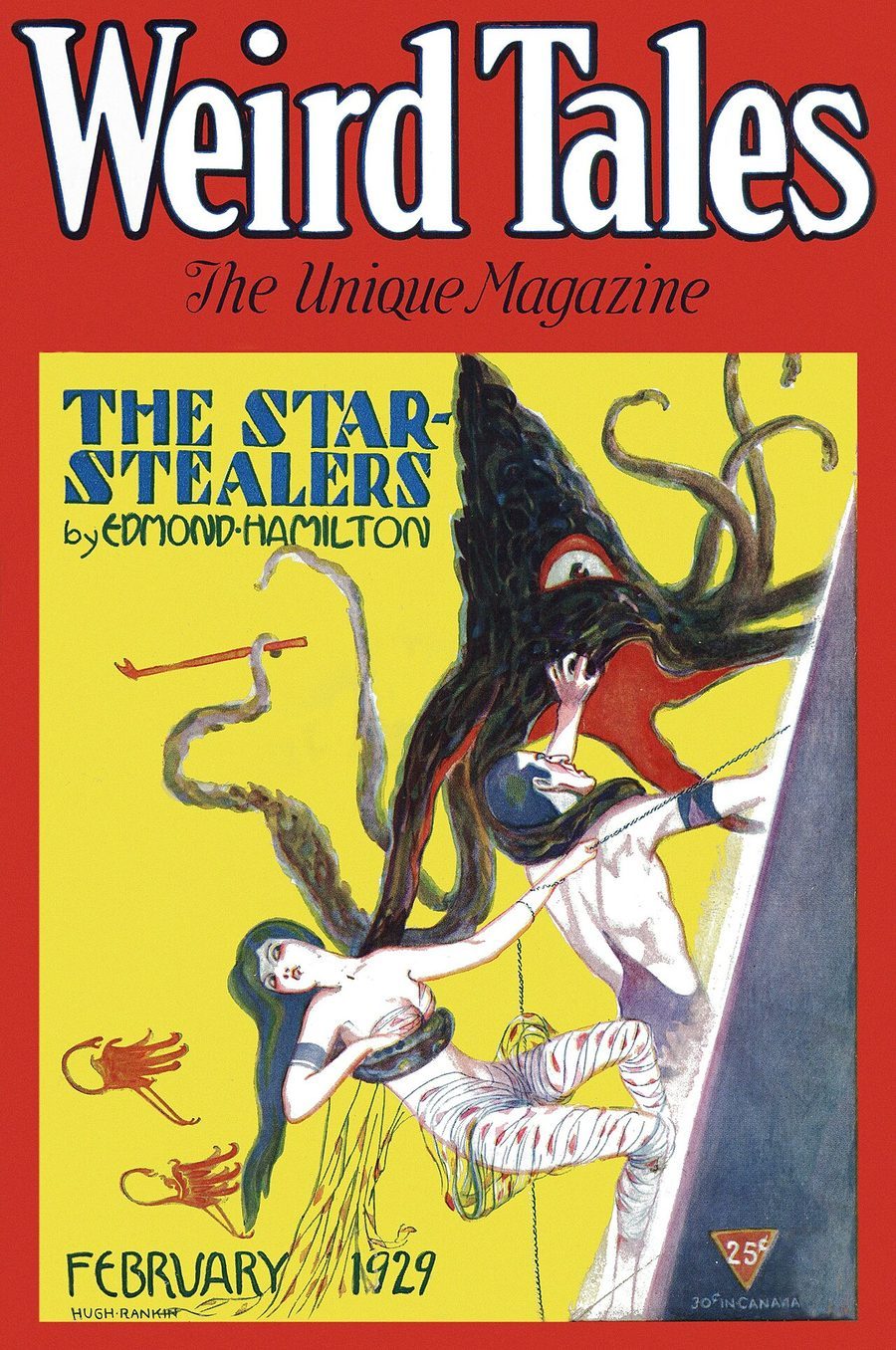
L’Appel de Cthulhu — Weird Tales, 1928 (numéro de l’année, pas forcément celui-ci) · Le Survivant — Weird Tales, juillet 1954 · L’Abomination de Dunwich — Weird Tales, 1929 (numéro de l’année, pas forcément celui-ci)
Fiches qui renvoient ici
Le mythe de Cthulhu · Inspecteur John Raymond Legrasse · Le culte · Le Necronomicon · Le Pacifique Sud · Les Grands Anciens · L’idole de Cthulhu · R’lyeh