Rapport
5 œuvres sur 222, 17 occurrences — 63ᵉ entité la plus citée du wiki sur 139. Parutions transcrites de 1928 (L’Appel de Cthulhu) à 1936 (Le Cauchemar d’Innsmouth), sur 4 œuvres datées. (dates des numéros transcrits, posthumes comprises.) Le foyer est L’Appel de Cthulhu : 10 occurrences, 59 % du total. Densité : 1,9 occurrence pour 10 000 mots dans les œuvres concernées. Voisine surtout Cthulhu : 17 rapprochements dans un même passage. 3 fiches du wiki y renvoient.
R’lyeh remonte le 1er mars 1925 par 47°9’ de latitude sud et 126°43’ de longitude ouest — Lovecraft donne des coordonnées, ce qui est tout son art : un point vérifiable au milieu de l’impossible.
Sa géométrie est fausse. Les angles qui devraient être aigus se comportent comme des obtus ; un marin qui court sur une arête tombe dedans. La cité n’est pas décrite comme laide mais comme mal construite, au sens mathématique.
Attestations dans le corpus
| Œuvre | Année | Occurrences | Part |
|---|---|---|---|
| L’Appel de Cthulhu | 1928 | 10 | 59 % |
| La Chevelure de Méduse | — | 3 | 18 % |
| Celui qui chuchotait dans les ténèbres | 1931 | 2 | 12 % |
| L’Homme de pierre | 1932 | 1 | 6 % |
| Le Cauchemar d’Innsmouth | 1936 | 1 | 6 % |
| Total | 17 |
Ce que le corpus en dit
Une phrase par œuvre, prise à l’endroit de la première occurrence.
The two sounds most frequently repeated are those rendered by the letters “Cthulhu” and “R’lyeh”. On March 23rd, the manuscript continued, Wilcox failed to appear; and inquiries at his quarters revealed that he had been stricken with an obscure sort of fever and taken to the home of his family in Waterman Street.
— L’Appel de Cthulhu, 10 occurrences
All of you had better watch out if ever I chant the old rites or try to call up what lies hidden in Yuggoth, Zimbabwe, and R’lyeh.
— La Chevelure de Méduse, 3 occurrences
I found myself faced by names and terms that I had heard elsewhere in the most hideous of connections—Yuggoth, Great Cthulhu, Tsathoggua, YogSothoth, R’lyeh, Nyarlathotep, Azathoth, Hastur, Yian, Leng, the Lake of Hali, Bethmoora, the Yellow Sign, L’mur-Kathulos, Bran, and the Magnum Innominandum—and was drawn back through nameless aeons and inconceivable dimensions to worlds of elder, …
— Celui qui chuchotait dans les ténèbres, 2 occurrences
“March 1—Iä R’lyeh! Praise the Lord Tsathoggua! I’ve got the son of hell at last! Told him I’d found a new ledge of friable limestone down this way, and he trotted after me like the yellow cur he is!
Ph’nglui mglw’nafh Cthulhu R’lyeh wgah-nagl fhtagn—” Old Zadok was fast lapsing into stark raving, and I held my breath.
Rencontres dans le texte
Entités dont une occurrence figure à moins de 320 signes de celle-ci — même phrase ou phrase voisine.
The chant meant only this: “In his house at R’lyeh dead Cthulhu waits dreaming.” Only two of the prisoners were found sane enough to be hanged, and the rest were committed to various institutions.
— L’Appel de Cthulhu, avec Cthulhu
What, in substance, both the Eskimo wizards and the Louisiana swamp-priests had chanted to their kindred idols was something very like this—the word-divisions being guessed at from traditional breaks in the phrase as chanted aloud: “Ph’nglui mglw’nafh Cthulhu R’lyeh, wgah’nagl fhtagn.” Legrasse had one point in advance of Professor Webb, for several among his mongrel prisoners had repeated to him what older celebrants had told them the words meant.
Croisements
Entités qui partagent ses œuvres, les plus spécifiques d’abord ; entre parenthèses, le nombre d’œuvres communes.
Personnages — Albert N. Wilmarth (1), Henry Wentworth Akeley (1), Inspecteur John Raymond Legrasse (1), Zadok Allen (1), Capitaine Obed Marsh (1)
Divinités — Cthulhu (4), Shub-Niggurath (3), Tsathoggua (2)
Créatures — Les Anciens (3), Les Grands Anciens (3), Les Mi-Go (1)
Lieux — Y’ha-nthlei (1), La Nouvelle-Orléans (2), Yuggoth (2), Le Récif du Diable (1), Le Pacifique Sud (2), Boston (3), Université Miskatonic (2)
Objets — Les cylindres des Mi-Go (1), L’idole de Cthulhu (1), Le Necronomicon (3)
Thématiques — Le document comme preuve (2), Le narrateur qui ne peut pas dire (2), Le racisme de Lovecraft (2), Le cosmicisme (2), L’architecture non euclidienne (1), Le culte (1)
Époques — Les années 1920 (2)
Cycles — Le mythe de Cthulhu (3)
Entourage — Clark Ashton Smith (3)
Dans les revues
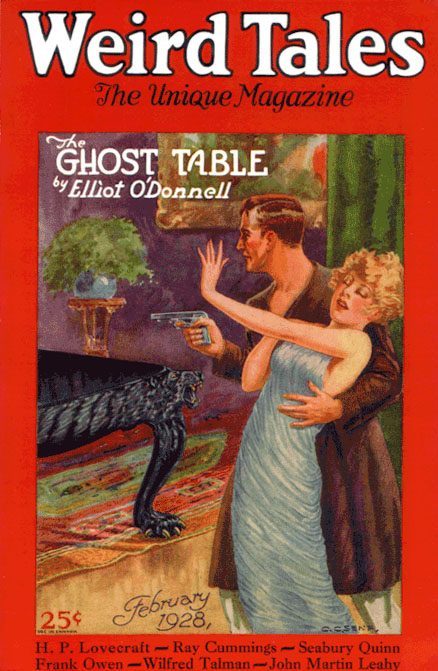
L’Appel de Cthulhu — Weird Tales, 1928 (numéro de l’année, pas forcément celui-ci)
Fiches qui renvoient ici
Cthulhu · L’architecture non euclidienne · Le Pacifique Sud