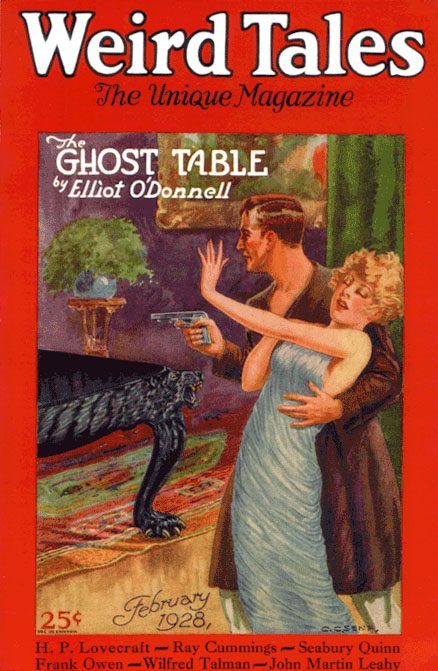
Weird Tales en 1928 — couverture d’un numéro de cette année-là, pas nécessairement celui-ci — Sant Erwan · CC BY-SA 4.0 · Commons

Incipit
“Of such great powers or beings there may be conceivably a survival … a survival of a hugely remote period when … consciousness was manifested, perhaps, in shapes and forms long since withdrawn before the tide of advancing humanity … forms of which poetry and legend alone have caught a flying memory and called them gods, monsters, mythical beings of all sorts and kinds… .” —Algernon Blackwood. Found among the papers of the late Francis Wayland Thurston, of Boston. 1. The Horror in Clay. The most merciful thing in the world, I think, is the inability of the human mind to cor …
11,873 mots · Récit · texte intégral sur Wikisource.
Version transcrite — Weird Tales, 1928 (vol. 11, n° 2). (Le numéro dont Wikisource donne le texte ; ce n’est pas toujours la première parution.)
Ce que ce texte contient
Personnages — Inspecteur John Raymond Legrasse (20), Abdul Alhazred (1)
Divinités — Cthulhu (22)
Créatures — Les Grands Anciens (11)
Lieux — R’lyeh (10), La Nouvelle-Orléans (5), Providence (4), Boston (2), Irem (1), Le Pacifique Sud (1)
Objets — L’idole de Cthulhu (21), Le Necronomicon (1)
Thématiques — L’architecture non euclidienne, Le cosmicisme, Le culte, Le document comme preuve, Le narrateur qui ne peut pas dire, Le racisme de Lovecraft
Époques — Les années 1920
Cycles — Le mythe de Cthulhu
Entourage — Clark Ashton Smith (1)