Rapport
1 œuvre sur 222, 21 occurrences — 53ᵉ entité la plus citée du wiki sur 139. Une seule parution datée : 1928 (L’Appel de Cthulhu). Voisine surtout Inspecteur John Raymond Legrasse : 7 rapprochements dans un même passage.
Saisie dans les marais de Louisiane, elle passe entre les mains d’un policier, d’un congrès d’archéologues et d’un professeur de sémitique. Aucun minéralogiste ne l’identifie.
Sa fonction est probatoire : c’est l’objet matériel qui force le narrateur à prendre au sérieux des documents qu’il croyait délirants.
Attestations dans le corpus
| Œuvre | Année | Occurrences | Part |
|---|---|---|---|
| L’Appel de Cthulhu | 1928 | 21 | 100 % |
| Total | 21 |
Ce que le corpus en dit
Une phrase par œuvre, prise à l’endroit de la première occurrence.
For what could be the meaning of the queer clay bas-relief and the disjointed jottings, ramblings, and cuttings which I found?
— L’Appel de Cthulhu, 21 occurrences
Rencontres dans le texte
Entités dont une occurrence figure à moins de 320 signes de celle-ci — même phrase ou phrase voisine.
| Entité | Rapprochements | Œuvre où c’est le plus net |
|---|---|---|
| Inspecteur John Raymond Legrasse | 7 | L’Appel de Cthulhu |
| Cthulhu | 5 | L’Appel de Cthulhu |
| La Nouvelle-Orléans | 3 | L’Appel de Cthulhu |
| Les Grands Anciens | 2 | L’Appel de Cthulhu |
| R’lyeh | 2 | L’Appel de Cthulhu |
| Providence | 1 | L’Appel de Cthulhu |
The Tale of Inspector Legrasse. The older matters which had made the sculptor’s dream and bas-relief so significant to my uncle formed the subject of the second half of his long manuscript.
The carven idol was great Cthulhu, but none might say whether or not the others were precisely like him. No one could read the old writing now, but things were told by word of mouth.
— L’Appel de Cthulhu, avec Cthulhu
The statuette, idol, fetish, or whatever it was, had been captured some months before in the wooded swamps south of New Orleans during a raid on a supposed voodoo meeting; and so singular and hideous were the rites connected with it, that the police could not but realize that they had stumbled on a dark cult totally unknown to them, and infinitely more diabolic than even the blackest of the African voodoo circles.
Croisements
Entités qui partagent ses œuvres, les plus spécifiques d’abord ; entre parenthèses, le nombre d’œuvres communes.
Personnages — Inspecteur John Raymond Legrasse (1), Abdul Alhazred (1)
Divinités — Cthulhu (1)
Créatures — Les Grands Anciens (1)
Lieux — R’lyeh (1), Irem (1), La Nouvelle-Orléans (1), Le Pacifique Sud (1), Providence (1), Boston (1)
Objets — Le Necronomicon (1)
Thématiques — L’architecture non euclidienne (1), Le culte (1), Le document comme preuve (1), Le narrateur qui ne peut pas dire (1), Le racisme de Lovecraft (1), Le cosmicisme (1)
Époques — Les années 1920 (1)
Cycles — Le mythe de Cthulhu (1)
Entourage — Clark Ashton Smith (1)
Dans les revues
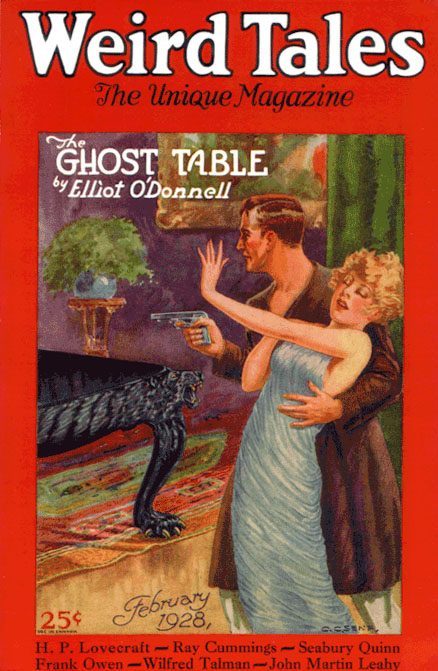
L’Appel de Cthulhu — Weird Tales, 1928 (numéro de l’année, pas forcément celui-ci)