Rapport
10 œuvres sur 222, 18 occurrences — 60ᵉ entité la plus citée du wiki sur 139. Parutions transcrites de 1931 (Celui qui chuchotait dans les ténèbres) à 1954 (Le Survivant), sur 9 œuvres datées. (dates des numéros transcrits, posthumes comprises.) Le foyer est La Quête onirique de Kadath l’inconnue : 4 occurrences, 22 % du total. Densité : 1,3 occurrence pour 10 000 mots dans les œuvres concernées. Voisine surtout Barzai le Sage : 9 rapprochements dans un même passage. 3 fiches du wiki y renvoient.
Plus vieux que l’homme, les Manuscrits pnakotiques viennent de Pnakotus, la cité de la Grande Race. Ils circulent jusque dans les Contrées du Rêve, où les prêtres de Ulthar en gardent une copie.
Leur intérêt est de précéder : là où le Necronomicon est le savoir d’un homme, les Manuscrits sont le savoir d’une espèce disparue avant nous.
Attestations dans le corpus
| Œuvre | Année | Occurrences | Part |
|---|---|---|---|
| La Quête onirique de Kadath l’inconnue | 1943 | 4 | 22 % |
| Les Autres Dieux | — | 4 | 22 % |
| Polaris | 1937 | 2 | 11 % |
| L’Horreur dans le musée | 1933 | 2 | 11 % |
| Hors du temps | 1933 | 1 | 6 % |
| Le Journal d’Alonzo Typer | 1938 | 1 | 6 % |
| Celui qui hantait les ténèbres | 1936 | 1 | 6 % |
| Le Survivant | 1954 | 1 | 6 % |
| Celui qui chuchotait dans les ténèbres | 1931 | 1 | 6 % |
| À travers les portes de la Clef d’argent | 1951 | 1 | 6 % |
| Total | 18 |
Ce que le corpus en dit
Une phrase par œuvre, prise à l’endroit de la première occurrence.
Then one very ancient Zoog recalled a thing unheard-of by the others; and said that in Ulthar, beyond the River Skai, there still lingered the last copy of those inconceivably old Pnakotic Manuscripts made by waking men in forgotten boreal kingdoms and borne into the land of dreams when the hairy cannibal Gnophkehs overcame many-templed Olathoe and slew all the heroes of the land of Lomar.
— La Quête onirique de Kadath l’inconnue, 4 occurrences
In Ulthar, which lies beyond the river Skai, once dwelt an old man avid to behold the gods of earth; a man deeply learned in the seven cryptical books of earth, and familiar with the Pnakotic Manuscripts of distant and frozen Lomar.
— Les Autres Dieux, 4 occurrences
But my eyes were the keenest in the city, despite the long hours I gave each day to the study of the Pnakotic manuscripts and the wisdom of the Zobnarian Fathers; so my friend, desiring not to doom me to inaction, rewarded me with that duty which was second to nothing in importance.
— Polaris, 2 occurrences
… trips to Tibet, the African interior, the Arabian desert, the Amazon valley, Alaska, and certain little-known islands of the South Pacific, plus claims of having read such monstrous and half-fabulous books as the prehistoric Pnakotic fragments and the Dhol chants attributed to malign and non-human Leng—but nothing in all this had been so unmistakably insane as what had cropped out that June evening under the spell of the whisky.
— L’Horreur dans le musée, 2 occurrences
It is true that a few scholars, unusually versed in the literature of occultism and magic, found vague resemblances between some of the hieroglyphs and certain primal symbols described or cited in two or three very ancient, obscure, and esoteric texts such as the Book of Eibon, reputed to descend from forgotten Hyperborea; the Pnakotic fragments, alleged to be pre-human; and the monstrous and forbidden Necronomicon of the mad Arab Abdul Alhazred.
I had never seen the text of the Pnakotic Manuscripts or of the Eltdown Shards before, and would not have come here had I known what they contain.
Rencontres dans le texte
Entités dont une occurrence figure à moins de 320 signes de celle-ci — même phrase ou phrase voisine.
Now it is told in the moldy Pnakotic Manuscripts that Sansu found naught but wordless ice and rock when he did climb Hatheg-Kla in the youth of the world. Yet when the men of Ulthar and Nir and Hatheg crushed their fears and scaled that haunted steep by day in search of Barzai the Wise, they found graven in the naked stone of the summit a curious and cyclopean symbol fifty cubits wide, as if the rock had been riven by some titanic chisel.
— Les Autres Dieux, avec Ulthar
It’s from N’kai that frightful Tsathoggua came—you know, the amorphous, toad-like god-creature mentioned in the Pnakotic Manuscripts and the Necronomicon and the Commoriom myth-cycle preserved by the Atlantean high-priest Klarkash-Ton.
— Celui qui chuchotait dans les ténèbres, avec Le Necronomicon
Croisements
Entités qui partagent ses œuvres, les plus spécifiques d’abord ; entre parenthèses, le nombre d’œuvres communes.
Personnages — Barzai le Sage (2), Richard Upton Pickman (3), Albert N. Wilmarth (1)
Divinités — Tsathoggua (4), Shub-Niggurath (5), Yog-Sothoth (5), Les Autres Dieux (3), Azathoth (4), Yig (2), Cthulhu (4), Nyarlathotep (3)
Créatures — Les Anciens (3), Les Goules (4), Les Maigres Bêtes de la nuit (2)
Lieux — Le plateau de Leng (5), Yuggoth (5), La Nouvelle-Orléans (3), Ulthar (3), Providence (4), Kadath l’inconnue (2), Les Contrées du Rêve (2), Dylath-Leen (1)
Objets — De Vermis Mysteriis (3), Unaussprechlichen Kulten (4), Le Necronomicon (6), Le Livre d’Eibon (3), Cultes des Goules (2)
Thématiques — La conscience emprisonnée (2)
Cycles — Le mythe comme œuvre collective (2)
Entourage — August Derleth (1)
Dans les revues
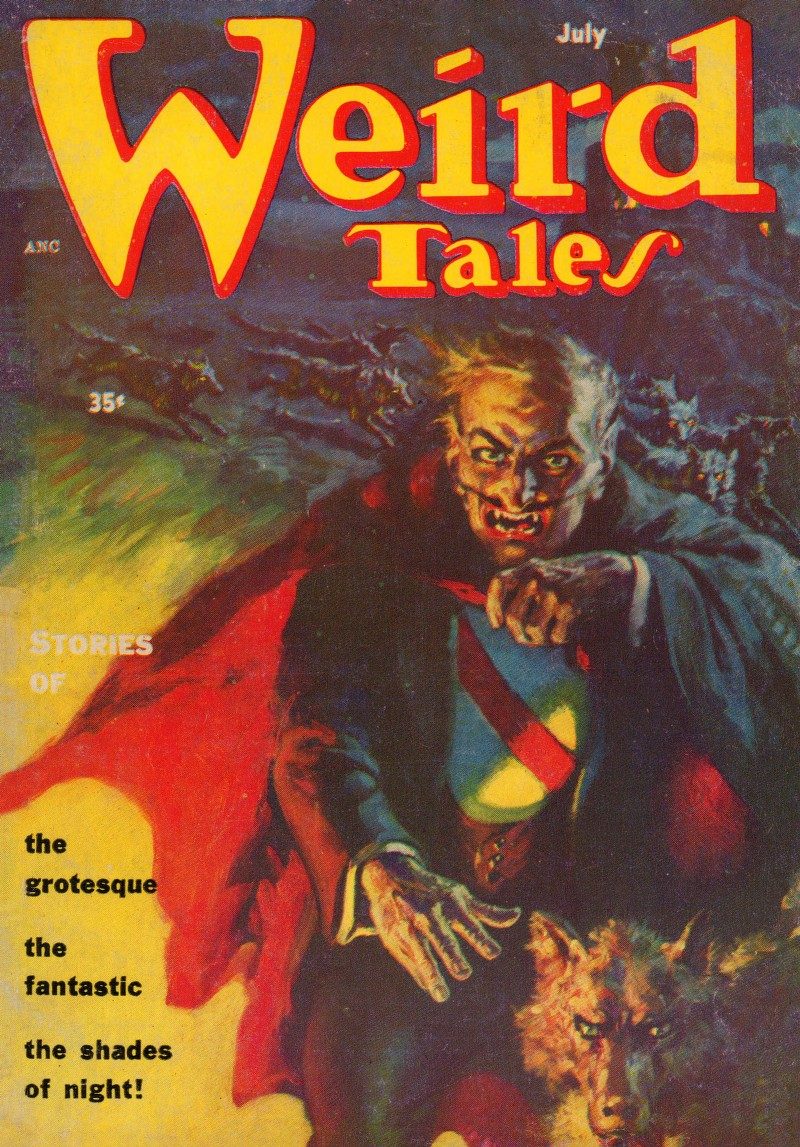
Le Survivant — Weird Tales, juillet 1954
Fiches qui renvoient ici
La Grande Race de Yith · Le Necronomicon · Le plateau de Leng